
Can I Add a Solar Battery and Keep My Feed-in Tariff?

Picture of Perry Williams
Perry Williams

Director of Recharge Renewable

If you installed solar panels in the UK before the Feed-in Tariff (FiT) scheme closed in 2019, there’s a good chance you’re still benefiting from generation payments every year. But as battery prices fall and homeowners look to maximise how much solar energy they use themselves, a common question comes up:

Can I add a battery to my existing solar setup without losing my Feed-in Tariff?

The short answer, yes. With the correct approach, you can install a battery and keep your FiT payments intact, while also enjoying the extra benefits that battery storage brings.

Let’s break down what this means in simple terms, and how you can do it the right way.

What Is the Feed-in Tariff (FiT)?

The FiT scheme was introduced by the UK government to encourage homeowners to generate their own renewable electricity. If you joined while the scheme was open (before 31 March 2019), you receive payments for both:

Generation – a fixed amount for every unit (kWh) your solar panels produce

Export – an additional amount for surplus electricity sent back to the grid

These payments are guaranteed under your contract, and generation payments in particular will continue for the full term of your FiT agreement as long as your system remains compliant.

The Growth of Solar in the UK – Why FiT Still Matters

The Feed-in Tariff scheme played a major role in driving solar adoption across the UK.

When the scheme launched in 2010, rooftop solar was still relatively niche — with only around 30,000 installations nationwide. But thanks to FiT incentives, adoption accelerated rapidly throughout the 2010s.

By:

  • 2015 – the UK had reached roughly 700,000 installations

  • 2020 – installations had grown to around 1.2 million

  • 2025 – the UK now has approximately 1.5 million solar installations

That’s a fifty-fold increase since the scheme began.

This growth highlights two important things:

1. FiT successfully created a large base of solar homeowners who are still receiving generation payments today.

2. Many of these systems are now 5–15 years old — meaning homeowners are increasingly looking at battery storage as the next logical upgrade.

If you installed solar during the FiT boom years (2010–2018), you’re part of this rapidly expanded generation of UK solar adopters — and adding battery storage is often the natural next step to increase self-consumption and future-proof your system.
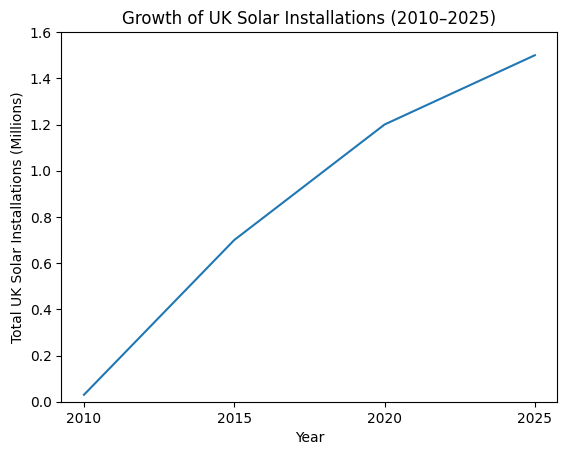
Figure 1: Growth of UK Solar Installations (2010–2025). Rapid adoption during the Feed-in Tariff years created over 1.5 million UK solar installations.

Can I Add a Battery and Still Keep My Feed-in Tariff?

Yes, adding battery storage to your existing FiT-registered solar system will not automatically cancel your Feed-in Tariff.

Why?

FiT generation payments are based solely on the amount of electricity your solar panels produce. They aren’t affected by how you use that energy — for example:

1. Whether you use it in your home

2. Store it in a battery

3. Or send it to the grid

As long as your solar panels and generation meter remain unchanged and compliant under your FiT agreement, your generation payments continue.

This means you can benefit from battery storage without jeopardising the core income you’re already receiving.

Important Things to Know Before You Install a Battery

While adding a battery generally won’t cancel FiT generation payments, there are a few practical and regulatory points worth understanding:

1. Check with Your FiT Provider First

You must let your FiT licensee know you plan to add battery storage before the installation begins. They’ll guide you on any information they require to keep your tariff valid.

2. Keep the Original Metering Setup

Your existing generation meter must remain untouched. This ensures it keeps measuring only the energy your solar panels produce, not the energy that’s being stored and later used from a battery.

If your system requires changes to metering (for example, installing a bi-directional meter), planning ahead helps ensure you stay compliant.

3. What About Export Payments?

Adding a battery could change how much electricity you export to the grid — and therefore your export tariff payments. Many FiT export tariffs were based on a “deemed export” assumption (e.g., that 50 % of your solar output is sent back to the grid). But a battery tends to store surplus energy for self-use instead of exporting it, which can reduce those export payments.

However, in many cases the generation payment makes up the majority of your FiT income — and the benefits of battery storage (lower grid import and more self-consumption) often outweigh the loss in export revenue.

What Battery Storage Really Changes: Self-Consumption vs Export

One of the biggest practical changes after adding a battery isn’t your FiT generation payment (that stays based on what your panels produce), it’s where your solar power ends up.

In real-world UK homes with solar + battery systems, a much larger share of solar electricity is used inside the home rather than pushed back onto the grid. For example, analysis of a sample of UK solar-and-battery households found that, on average:

  • 54% of solar generation was self-consumed (used in the home)

  • 46% was exported to the grid

This is important for FiT households because many older FiT export payments are “deemed”, historically based on an assumption that 50% of what you generate is exported, regardless of what actually happens.

So if you switch from deemed export to metered export (for example, to take a Smart Export Guarantee tariff), a battery can reduce exports and therefore lower export revenue — but it often increases your bill savings because you’re buying less electricity from the grid.

In short: batteries mainly shift your solar from “exported” to “used at home”, which is exactly why they’re so effective for reducing electricity bills, even if export payments change.
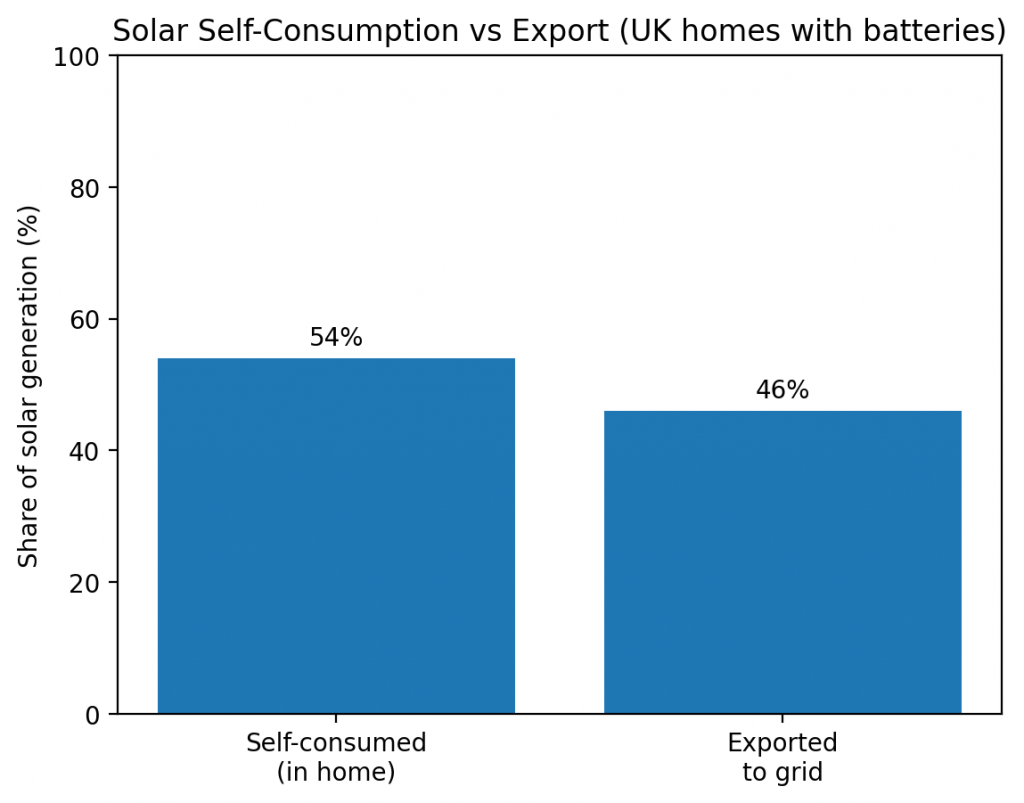
Figure 2: Solar self-consumption vs export (UK homes with batteries) — Example split showing how batteries increase the share of solar used in the home (54%) vs exported (46%).

Benefits of Adding Battery Storage to Your Solar System

Installing a battery alongside your solar PV brings several key advantages:

More Self-Use = More Savings

Instead of exporting excess solar electricity, you can store it and use it when your panels aren’t generating — like in the evenings or early mornings. This reduces how much you import from the grid.

Lower Energy Bills

By using your stored solar power during peak tariff periods, you reduce your reliance on expensive grid electricity, which can significantly lower your bills.

Energy Resilience

Some battery systems offer backup power during outages — keeping essential appliances running when the grid can’t.

Future-Proof Your Home

With energy costs rising and tariffs evolving, storage helps you make the most of your solar investment.

Solar’s Growing Role in the UK Energy Mix

Solar power is no longer a niche technology in the UK energy system, it now plays a meaningful role in national electricity generation.

According to the latest UK energy data, solar contributes approximately 6.4% of total UK electricity generation annually.

While that may sound modest at first glance, it represents:

1. Over 21 GW of installed solar capacity

2. More than 1.5 million installations nationwide

3. Regular summer days where solar can supply over 30% of instantaneous electricity demand

This matters for FiT homeowners because it shows:

1. Solar is now a mainstream part of the UK grid.

2. Your rooftop system is part of a nationally significant energy shift.

3. As solar penetration rises, energy storage becomes increasingly valuable for balancing demand and maximising self-use.

In other words, battery storage isn’t just a personal upgrade, it’s aligned with how the UK grid is evolving.
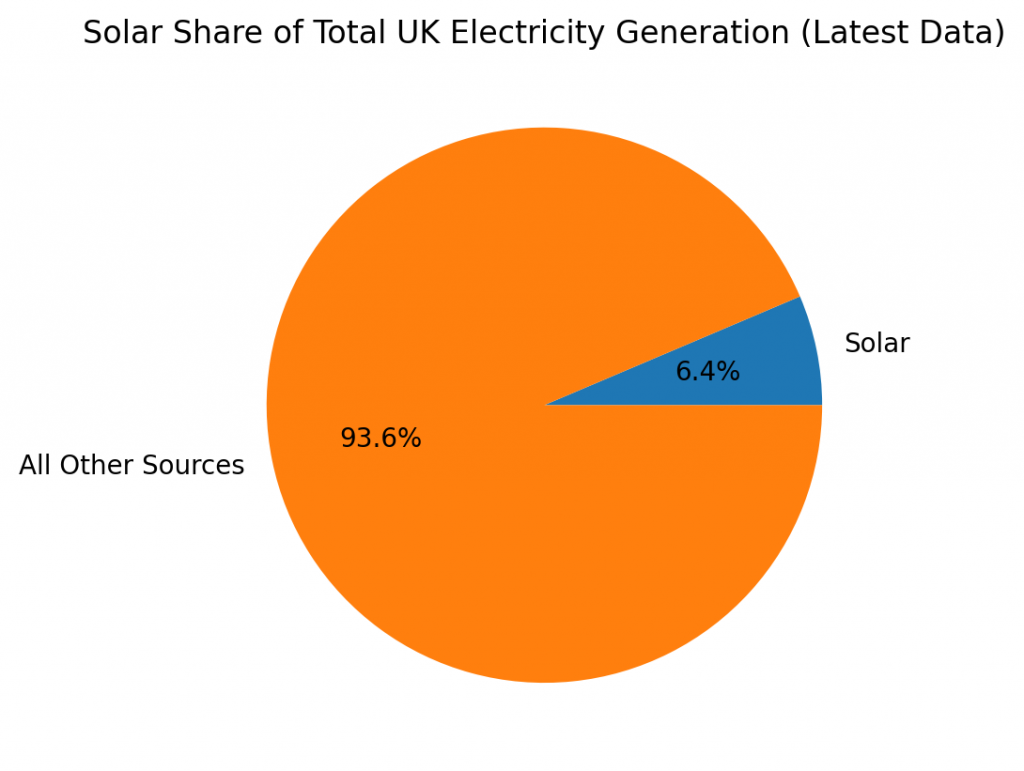
Figure 3: Solar share of total UK electricity generation (latest data). Solar now contributes around 6.4% of the UK’s annual electricity supply.

Do I Need a Specific Type of System?

There are generally two ways battery systems are connected to your solar setup:

AC-Coupled Systems
  • Battery and inverter sit alongside your existing solar system.

  • Does not require replacing your current solar inverter.

  • Keeps your generation meter exactly as it was.

  • Typically simpler to install in a way that keeps FiT compliance.

DC-Coupled (Hybrid) Systems
  • Requires replacing your current solar inverter with a hybrid unit.

  • These can be more efficient.

  • May need careful metering planning to ensure compliance.

Your installer (like Recharge Renewable) will be able to review your system and recommend the best option.

What’s the Bottom Line?

Yes: you can add battery storage to your existing solar system and keep your Feed-in Tariff generation payments.

Just be sure to notify your FiT provider and protect the original metering configuration.

Export tariff dynamics might change, but the benefits of energy storage usually make it worthwhile.

How Recharge Renewable Can Help

At Recharge Renewable, we specialise in helping solar homeowners integrate energy storage smoothly and compliantly:

  • We’ll review your current solar and FiT setup.

  • Advise on the best battery options for you — whether AC- or DC-coupled.

  • Ensure all metering and paperwork is handled properly so you keep your FiT income.

  • Design your system to maximise savings, self-consumption, and long-term performance.

Ready to add a battery and take more control of your energy? Contact Recharge Renewable for a free assessment and tailored proposal today.

Get in touch
WE ARE HERE TO HELP

If you’d like to discuss a quote or have any questions or queries please give us a call, send an email or use the contact form. We look forward to hearing from you!

Perry Circle Border
Perry Williams
Founder